by Steven Lindner | Sep 2, 2024 | Candidate Assessment and Selection, Hiring and Retention, Recruitment Process Outsourcing, Research Publication, Talent Acquisition |
Steven Lindner, Ph.D., is a prominent figure in the field of talent acquisition and human resources. He is the Managing Partner of The WorkPlace Group, a company specializing in recruitment process outsourcing (RPO) and talent acquisition solutions. With a Ph.D. in Industrial/Organizational Psychology, Dr. Lindner has dedicated his career to understanding and improving the hiring process.
Dr. Lindner is recognized as one of the creators of the RPO industry. He pioneered innovative approaches to streamlining and enhancing recruitment processes, and his contributions have significantly shaped the way organizations manage their talent acquisition strategies.
In addition to his groundbreaking work in RPO, Dr. Lindner has authored over 85 HR business and research articles in leading media outlets and academic journals. He also served as a member of the Society for Human Resource Management (SHRM) Talent Acquisition Expert Panel and is a contributing author to the American National Standard, “Cost-Per-Hire”. This standard provides a comprehensive framework for calculating the cost associated with hiring new employees, helping organizations better understand and manage their recruitment expenses.
Dr. Lindner’s work focuses on evidence-based recruitment strategies.” He has co-authored studies on resume characteristics that influence interview decisions, highlighting the importance of relevant work experience, educational background, and achievements in securing job interviews. He has published scientific studies on loneliness at work, work-from-home, sources of hire, job search strategies, hiring costs, candidate assessments and a range of related talent acquisition topics. His research emphasizes the need for a scientific approach to hiring, ensuring that candidates are selected based on objective criteria rather than subjective biases.
Through his innovative methodologies, Dr. Lindner has empowered employers with more effective hiring practices. By leveraging data-driven insights and advanced recruitment technologies, he has enabled organizations to identify and attract top talent more efficiently. His strategies enable employers to respond swiftly to their hiring needs, ensuring they can fill critical positions with qualified candidates in a timely manner.
 When asked how he and his organization, The WorkPlace Group, do it better, Dr. Lindner said, “Anyone can recruit, but few know how to do it well. There is a science to selecting candidates who will perform well, add value to the business, and stay committed.” But apart from the science, isn’t it about knowing good job candidates and having a strong network of people? To this, Dr. Lindner remarked, “It’s no longer about the size of your candidate database, LinkedIn connections or the number of candidates in your network. It’s about knowing how to select the right talent with the competencies, work experiences, and work philosophies to succeed within your organization.”
“Succeed within your organization” is a key phrase. To further explain his view, Dr. Lindner uses the example of Employee Referrals. Employee Referral programs are a common recruitment strategy. They account for approximately one-third of most companies’ new hires. Furthermore, employees generally receive a financial incentive for recommending candidates who are hired. However, he quickly points out that employee referrals are not always the best hire. There is a difference between knowing someone and having objective knowledge and first-hand observations of how someone performed during critical decision-making or make-or-break moments of getting work done. Furthermore, we all know great people who did great work elsewhere but failed to do so in the same or similar job with the next employer.
But can’t Artificial Intelligence (AI) hire better? Do we still need Organizational Psychologists and Recruiters to make good hires? To this, Dr. Lindner responded, ‘While AI helps automate repetitive recruiting tasks, recruitment methodology and human decision-making are key to successful hiring.’ Jokingly, he said, “When recruitment AI fails, who do you call? Answer: A human.” For now, solutions to how to do it better and the creation of novel ideas and solutions remain strictly a human ability.
Recognizably, most employers don’t have the recruitment, selection and hiring capabilities or expertise Dr. Lindner speaks about. When companies need to hire job candidates, most handle it using job ads and internal staff to review resumes and interview candidates. Larger companies may have additional resources such as recruiters, HR professionals and talent acquisition managers to sort resumes and screen job candidates.
When the do-it-yourself (DIY) approach fails, employers turn to staffing firms, contingent search groups and recruiting agencies. These are all very expensive options that often come with simple, cursory or uninformed reviews of job candidates’ qualifications. Staffing firms, contingent search groups, and recruiting agencies are in the business of acting as agents for candidates. As agents, they promote their candidates to multiple employers.
In contrast, Dr. Lindner’s organization, The WorkPlace Group, flips the paradigm and strictly represents the employer. This means candidates are being recruited and carefully assessed specifically for job openings in your organization. Dr. Lindner explains that his teams use all the same recruiting tactics, and then some, employed by headhunters, agencies, and staffing firms in addition to The WorkPlace Group’s database and network of over 700,000 job candidates.
The RPO industry that Dr. Lindner helped create has produced many RPO providers offering a myriad of choices and industry specializations for employers to consider. The WorkPlace Group’s model provides recruiting solutions for both small and large employers. Small companies can now have the same scalability, recruiting technologies, assessment abilities, job market intelligence and hiring capabilities as larger employers. Large companies can customize support options for managing and filling thousands of job openings across various locations and departments.
Steven Lindner, Ph.D., has profoundly impacted the talent acquisition industry through his innovative methodologies and scientific approach to hiring. By leveraging data-driven insights and advanced recruitment technologies, he has empowered employers to identify and attract top talent more efficiently. His emphasis on objective criteria and evidence-based practices ensures that candidates are selected based on their competencies, work experiences, and alignment with organizational values.
Dr. Lindner’s organization, The WorkPlace Group, stands out by strictly representing the employer, providing tailored recruitment solutions for both small and large companies. This approach allows smaller companies to access the same advanced recruiting technologies and market intelligence as larger firms, while large companies benefit from scalable support to manage extensive hiring needs.
As the recruitment landscape continues to evolve, Dr. Lindner’s and The WorkPlace Group’s contributions will remain pivotal in shaping effective and efficient talent acquisition strategies. Their commitment to excellence in hiring practices underscores the importance of combining human decision-making with technological advancements to achieve successful outcomes in the ever-changing job market.
This article also appears on:

CBS Lake Charles: https://pr.cbslakecharles.tv/article/The-Science-of-Hiring?storyId=66d6e0054629fe00082af8b9

NBC Fort Wayne’s: https://fwnbc.marketminute.com/article/syndicationcloud-2024-9-3-the-science-of-hiring

Fox47: https://fox47.marketminute.com/article/syndicationcloud-2024-9-3-the-science-of-hiring
For more information, contact:
Steven Lindner, Ph.D., steven.lindner@workplacegroup.com
Instagram: https://www.instagram.com/lindner.steven/
LinkedIn: https://www.linkedin.com/in/stevenlindner

by Steven Lindner | Jun 7, 2023 | Candidate Assessment and Selection, Remote Workforce, Talent Acquisition |
Click here to listen to the Podcast.
Ninety-five percent (95%) of employers offer work-from-home or hybrid work arrangements for jobs that can be performed from home. During the pandemic, work-from-home was a matter of public safety. Now it’s about productivity. Selecting who should work from home goes beyond having a quiet home office and a fast internet connection. There’s science behind the psychology of remote work. While teachable and trainable, only job candidates and employees who demonstrate a Readiness to Work from Home are likely to do so effectively. What are those psychological characteristics and work skills? A variety of factors are involved.
 Are employees working at home productive?
Most employees in jobs that can be done from home work from home. According to SHRM.org, employers expect hybrid work arrangements and work-from-home to remain unchanged in 2023.
But productivity is the greatest concern employers have of their employees working from home. A 2022 survey by Microsoft of 20,000 people in 11 countries found that “85% of leaders say that the shift to hybrid work [and by association work-from-home] has made it challenging to have confidence that employees are being productive.” Marc Zuckerberg, the CEO of Meta, announced on March 15, 2023, “An internal analysis of employee performance data suggests that engineers who work in person get more done” (Capot, 2023). A 2023 article by Kathryn Mayer, Amazon Nixes Employees’ Petition Against Return to Office, serves as another example, among many, of employers reinforcing their return-to-office policies in spite of employee protests. Return-to-office policies, requiring employees to work from corporate offices on most days of the week, don’t fully solve productivity concerns. Employees still need to have Readiness to Work from Home.
 Job design and workflow matter, but it’s not that simple!
Some jobs are better suited to be performed in-office than at home. For example, managing a manufacturing production line from home is not practical. But procuring raw materials from home is highly doable. To perform a job equivalently at home or in the office, the job design and workflow must enable both settings. For example, employees need to have the same exact software, hardware and work tools whether in a corporate office or a home office.
But homes are filled with distractions, and monitoring what employees do throughout the day is challenging. Just because a job can be performed effectively from home doesn’t mean everyone can perform effectively from home.
So, what should employers do?
 Select job candidates and employees who have demonstrated a Readiness to Work from Home.
Readiness to Work from Home is a psychological construct involving a variety of characteristics and work skills. All of which are teachable and trainable. Job candidates and employees with a Readiness to Work from Home are able to work effectively and productively in both remote and hybrid jobs.
Five essential characteristics and work skills to look for in job candidates and employees with a Readiness to Work from Home are:
 Communication Skills: Effective communication is essential for remote work. The ability to communicate clearly, ask questions, and provide feedback can help employees stay on track and feel connected to their team.
- Self-Motivation: Remote work requires self-discipline and self-motivation. Employees who are self-starters and able to manage their time effectively are more likely to be successful in a remote work environment.
- Technical Competence: Remote work relies heavily on technology, so employees must be comfortable with the tools and software used in their role. Additionally, they should have a good internet connection and reliable hardware to work efficiently.
- Adaptability: Flexibility and adaptability are crucial when working remotely. Employees must be able to adapt to changing circumstances, such as working across different time zones or dealing with technology issues.
- Integrity and Trustworthiness: Remote work requires a high degree of integrity and trust between employees and managers. Employers should look for employees who have a proven track record of reliability, responsibility, and trustworthiness. In other words, people who do the right thing even when no one is watching.
Need help hiring, training and selecting employees who are ready to work successfully from home? Want to learn how to do this better? We here at The WorkPlace Group are ready to help. For more information, please click here to contact us today.
by Steven Lindner | Jul 17, 2022 | Talent Acquisition |
Video has become an essential part of online communication. Businesses use it for product demonstrations, educators create video lessons, and independent creators rely on it to reach and engage their audiences.
However, creating a video is only the first step. Once the recording and editing are complete, the video needs a reliable place where it can be stored, streamed, managed, and shared.
This is where online video hosting becomes useful.
A dedicated video-hosting platform allows users to upload video files, generate shareable links, and make their content available through a web browser. It removes much of the technical work involved in configuring servers, managing bandwidth, and building a custom video player.
What Is Online Video Hosting?
Online video hosting is a service that stores video files on remote servers and makes them accessible through the internet.
After uploading a video, the user normally receives a viewing or sharing link. Viewers can then open the link and watch the supported video directly in their browser without receiving the original file through email or another transfer method.
A video-hosting platform may also provide features such as:
- Browser-based video playback
- Upload and file-management tools
- Mobile-friendly video players
- Shareable viewing links
- Storage for large video files
- Public or restricted sharing
- Basic activity and viewing reports
- Support for multiple media formats
These features make online hosting more practical than manually uploading video files to a traditional web server.
Why Normal File Storage Is Not Always Enough
General cloud-storage platforms are useful for keeping backups and sharing documents. However, they are not always designed for smooth video playback.
When a video is shared through a basic storage service, the recipient may need to download the entire file before watching it. This can be inconvenient when the file is large or the viewer has a slow internet connection.
An online video hosting platform is designed around video delivery. Instead of treating the upload like a normal document, the service prepares it for online access and browser playback.
This difference is particularly important for:
- Tutorials and online lessons
- Client preview videos
- Product demonstrations
- Recorded webinars
- Marketing videos
- Internal company training
- Portfolio presentations
- Community and membership content
A proper hosting workflow improves the experience for both the publisher and the viewer.
Key Benefits of Online Video Hosting
1. Easier Video Sharing
Large video files are difficult to send through email because most email services limit attachment sizes.
With video hosting, the creator uploads the file once and shares a link instead of repeatedly transferring the full video.
This approach is faster, cleaner, and easier to manage.
2. Browser-Based Playback
A major advantage of online hosting is that viewers can watch supported videos inside their web browser.
They do not need to install specialist software or download the complete file before playback begins. This makes the content more accessible on computers, tablets, and mobile phones.
3. Better File Management
Creators who publish regularly may quickly build a large video library.
A central dashboard helps users organize, rename, review, and remove their uploaded files. This is much easier than managing hundreds of video links across different folders and services.
4. Support for Large Files
High-resolution videos can be several gigabytes in size. Sending these files through messaging applications or email can be slow and unreliable.
Many hosting platforms also provide large file sharing features, allowing users to upload large videos and distribute them through a simple link.
5. Reduced Server Management
Self-hosting videos requires more than buying normal website hosting.
The site owner may need to manage:
- Server storage
- Bandwidth usage
- Video encoding
- Player compatibility
- Traffic spikes
- Security settings
- Browser and device support
A hosted solution handles much of this infrastructure, allowing creators to focus on producing and publishing content.
Important Features to Look For
Not all hosting platforms offer the same experience. Before choosing one, users should compare the features that affect their actual workflow.
Simple Upload Process
Uploading should be easy to understand. Users should be able to select or drag a video file into the dashboard without going through a complicated technical setup.
A progress indicator is also helpful when uploading larger files.
Mobile-Friendly Video Player
Many people watch videos on smartphones. The video player should automatically adjust to different screen sizes and remain easy to use on mobile devices.
Reliable Playback
A video should load and play consistently on modern browsers.
Playback performance may still depend on the viewer’s internet connection, device, location, and video size, but the hosting service should provide a stable delivery system.
Clear File Limits
Every platform has its own rules regarding maximum file size, total storage, bandwidth, and retention.
Users should review these limits before uploading important content, especially when working with high-resolution or long-form videos.
Content Organization
A useful dashboard should make it easy to find uploaded files.
Folders, search tools, file names, dates, and categories can help creators maintain a clean and manageable content library.
Sharing Controls
Some videos are intended for the public, while others should only be available to selected viewers.
A hosting platform should clearly explain its sharing options so that users understand how their content can be accessed.
File Activity
View and download information can help creators understand whether their content is being accessed.
Even basic reporting can be useful for identifying popular videos, inactive files, and content that may need to be updated.
Video Hosting for Creators
For independent publishers, video hosting for creators should be simple, flexible, and affordable.
Most creators do not need a complicated enterprise broadcasting system. They need a platform that allows them to upload a finished video, obtain a working link, and share it with their audience.
Common creator use cases include:
- Software tutorials
- Educational lessons
- Design walkthroughs
- Freelance portfolio videos
- Product reviews
- Recorded interviews
- Membership content
- Behind-the-scenes videos
Creators should also consider how frequently they upload and how long they need to keep their videos online.
A creator publishing one tutorial per month will have different storage requirements from a team uploading multiple large videos every day.
Online Video Hosting for Businesses
Businesses use video for both external and internal communication.
External video content may include product demonstrations, customer onboarding, advertisements, and company presentations.
Internal content may include:
- Employee training
- Recorded meetings
- Process documentation
- Security instructions
- Department updates
- Remote-work guidance
Centralized video hosting helps teams avoid sending large attachments or storing important recordings across multiple personal accounts.
It can also make content easier to update. When an older training video becomes inaccurate, the business can remove or replace it from the central library.
Public and Private Video Hosting
One of the most important decisions is whether a video should be public or private.
Public Video Hosting
Public videos are intended for wide distribution. These may be shared on websites, blogs, social networks, or public communities.
Public hosting is suitable for:
- Marketing content
- Free tutorials
- Product introductions
- Public announcements
- Open educational videos
Private Video Hosting
Private video hosting is more suitable when the audience should be limited.
Examples include:
- Client review files
- Internal company training
- Unreleased product previews
- Paid educational content
- Personal recordings
- Confidential presentations
However, users should not assume that a simple unlisted link provides complete confidentiality. A recipient may still copy and forward the link.
Highly sensitive content may require stronger access controls, authentication, password protection, encryption, or an enterprise content-management solution.
How to Upload and Watch Videos Online
The process to upload and watch videos online is normally straightforward.
Step 1: Prepare the Video
Before uploading, confirm that the video has been exported correctly.
Check:
- Video resolution
- Audio quality
- File format
- Total file size
- Title and filename
MP4 is widely used because it provides good compatibility and a practical balance between quality and file size.
Step 2: Upload the File
Sign in to the selected platform and choose the upload option.
Keep the browser window open until the upload is complete. The time required will depend on the video size and upload speed.
Step 3: Review the Uploaded Video
Once the file has been uploaded and processed, open it in the browser.
Check the video from beginning to end, paying attention to:
- Playback quality
- Audio synchronization
- Mobile responsiveness
- Loading time
- Video title
- Sharing permissions
Step 4: Copy the Sharing Link
After confirming that the video works properly, copy its public or restricted link.
Test the link in a private browser window before sending it to the audience. This helps confirm that the permissions are configured correctly.
Step 5: Share It Responsibly
The video link can be shared through:
- Email
- Messaging applications
- Websites
- Learning platforms
- Project-management tools
- Social media
- Community forums
Users should only share content they own or have permission to distribute.
FileMoon as an Online Video Hosting Option
Creators and online teams looking for a straightforward way to host videos and share other file types can explore the FileMoon online video hosting platform.
FileMoon allows users to upload supported video and file formats, manage uploads through a dashboard, and create links for online access and sharing.
A practical workflow may include:
- Exporting the final video in a compatible format
- Uploading it to FileMoon
- Adding a clear and descriptive file name
- Testing the video playback
- Reviewing the sharing settings
- Sending the link to the intended viewers
- Removing files that are no longer required
Before uploading important or sensitive content, users should always review the platform’s current terms, storage limits, copyright policy, and privacy settings.
Common Video-Hosting Mistakes
Uploading Extremely Large Uncompressed Files
An uncompressed video may take much longer to upload and stream.
Creators should export a web-friendly version that maintains acceptable quality without creating an unnecessarily large file.
Using Unclear File Names
Names such as final-video-2-new.mp4 become difficult to manage over time.
A clearer name would be:
website-security-guide-july-2026.mp4
Descriptive file names improve organization and reduce confusion.
Ignoring Mobile Viewers
A video that looks good on a desktop computer may not provide the same experience on a phone.
Always test playback and controls on at least one mobile device.
Sharing Sensitive Links Publicly
A private or client-only video link should not be posted on a public page, forum, or social-media profile.
Review the audience and permissions before publishing any link.
Keeping Only One Copy
Online hosting should not always be treated as the only backup.
Important videos should also be stored on a local computer, external drive, or separate backup service.
Ignoring Copyright Rules
Users should not upload movies, television programs, music videos, courses, or other protected material without authorization.
Video-hosting platforms may remove infringing files and restrict accounts that repeatedly violate copyright rules.
Frequently Asked Questions
What is the best online video hosting platform?
The best platform depends on the user’s storage needs, file sizes, audience, privacy requirements, budget, and required features. Creators should compare these factors instead of choosing a service based only on its popularity.
Can I host videos on my own website?
Yes, but self-hosting can consume significant storage and bandwidth. It may also require video optimization, server configuration, security management, and player testing.
For many creators, a dedicated video-hosting platform is easier to manage.
Can viewers watch hosted videos without downloading them?
Many platforms allow supported videos to play directly in a browser. However, availability may depend on the video format, account settings, and hosting provider.
Is private video hosting completely secure?
No online sharing method should automatically be considered completely secure.
A private or unlisted link may reduce public exposure, but recipients may still forward it. Sensitive material may require authentication and stronger security controls.
What video format is suitable for online hosting?
MP4 using a widely supported video and audio codec is commonly used for online playback. The exact supported formats should be confirmed through the hosting platform’s documentation.
Can video hosting also be used for large file sharing?
Some video-hosting services also support documents, images, archives, audio, and other file types. This can be helpful for creators who want to manage video content and project resources in one location.
Final Thoughts
Online video hosting gives creators, businesses, educators, and online teams a practical way to store, stream, manage, and share video content.
Instead of sending large attachments or configuring complicated server infrastructure, users can upload a video, test its playback, and distribute a link to the intended audience.
The right platform should provide reliable browser playback, clear storage limits, mobile compatibility, simple file management, and suitable sharing controls.
Most importantly, users should choose a hosting service based on their real requirements. A platform that works well for public tutorials may not be suitable for confidential training, while a highly restricted enterprise system may be unnecessary for a small creator.
By reviewing the available features and following responsible sharing practices, publishers can create a more organized, secure, and professional video workflow.
by Steven Lindner | Nov 24, 2015 | Hiring and Retention, Talent Acquisition |
With the shift from an employer job market to a candidate job market, recruiters continue to be pushed to their limits in trying to attract and recruit new talent to their organizations. In this increasingly competitive job market, we will either have to rethink the way we recruit and screen candidates or accept the fact that our time-to-fill metrics will continue creeping up. Below we provide six tips for how recruiters, talent acquisition professionals, and employers can take an inclusive approach to identifying hidden talent among the underemployed and the unemployed.
Labor Market Update
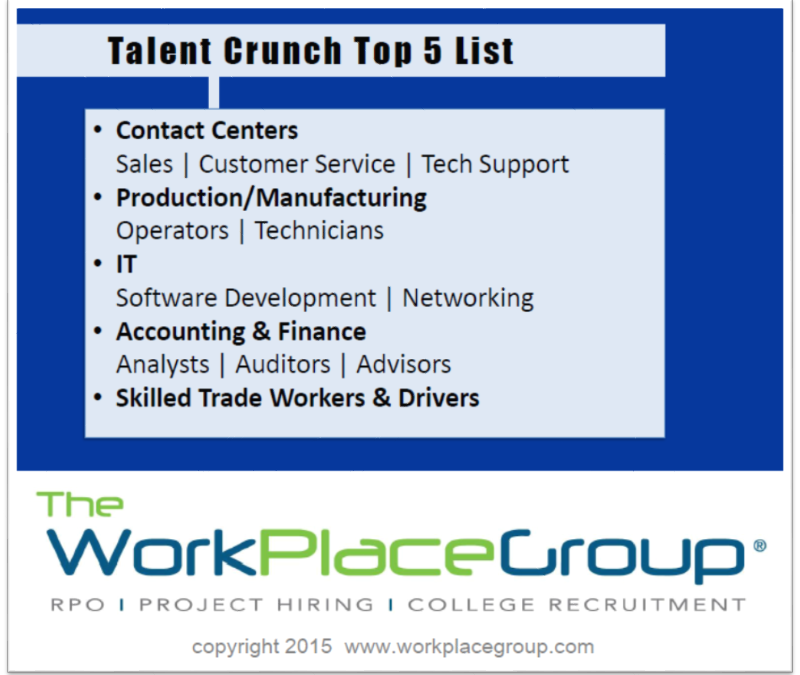
Companies continue to add 250,000 new jobs a month, driving our national unemployment rate down to 5%. In Why Its Hard to Find Talent for Entry Level and Hourly Positions, we show how the unemployment rate is projected to fall to 4.5% by August 2016. This is great news for our economy, but New Labor Market Realities: Recruiting Friend or Foe? shows the impact the talent crunch is having on talent acquisition across industries. Our Talent Crunch Top 5 List summarizes the talent shortage that exists in our current job market.
Since June 2015, our national unemployment has been inching downward. Jobs continue to be added, particularly in professional and business services. In addition to the Top 5 Talent Crunch list, engineering services, health care services (especially in ambulatory health care and hospitals), retail trade, and food and beverage services also have some of the fastest growing number of job openings.
Yet the latest BLS statistics1 show very little downward movement in the number of workers employed part time for economic reasons, i.e., because they are unable to find a full time job or their hours have been cut back. This is also true for the marginally attached, that is, individuals who have given up actively looking for work. These two groups combined account for millions of potential job candidates.
Just think of the following ratios: At the peak of the recession, there were almost 7 job seekers per job opening. Today, that number has dropped to just 1.4 job seekers per job opening.
So what are recruiters and talent acquisition professionals supposed to do?
How to Not Miss Out On Potentially Good Talent
Without outsourcing jobs to other countries or importing talent from other countries, recruiters will need to broaden their talent acquisition strategies to address the impending talent shortage.
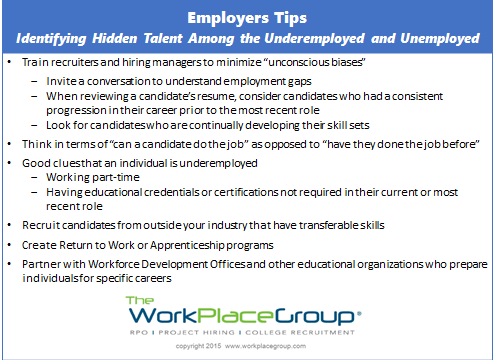
Recruiters and talent acquisition professionals will need to shift their organizations thinking — at least for some portion of their talent acquisition needs — from the jobs candidates have done to the jobs candidates can do. This shift in thinking means selecting candidates who want and can develop new skill sets. In other words, selecting candidates who lack the work experience but have successfully completed training programs or earned certificates and degrees from Workforce Development Offices and educational partners like Boot Camps, Trade Schools, and Colleges. Employers also may consider establishing their own Boot Camps, Apprenticeships, Return to Work programs, and training programs that help individuals re-enter the workforce or transition from other industries or positions.
When selecting candidates based on can do rather than have done, many things need to shift in terms of how recruiters and hiring managers assess candidates. Many tips and clues to look for on resumes and in social media profiles are included in Identifying Underemployed Workers.
Beyond talent acquisition and resume review, we need to change how we screen and evaluate candidates. The job interview process and the employment interview guide, in particular, needs to be re-examined. For example, job interview questions need to move from behavioral or experience-based questions to knowledge-based or situational questions. In order words, instead of asking what did you do when happened, you would ask what would you do or how would you do something?
When adding can do rather than have done candidates to your talent acquisition strategies, recruiters need to prepare and coach hiring managers to shift their thinking as well. Recruiters and talent acquisition professionals are well advised to educate internal corporate stakeholders on market realities and the talent crunch that now exists across multiple disciplines. Its also a good time to train hiring managers on unconscious hiring biases. After all, recruiters and talent acquisition professionals can find all the talent in the world, but we still need internal hiring managers to interview and make hire / no hire decisions.
For more insights on how to address talent acquisition needs please contact us.
1 The Employment Situation – October 2015. Bureau of Labor Statistics, November 6, 2015 (http://www.bls.gov/news.release/pdf/empsit.pdf).

by Steven Lindner | Oct 27, 2015 | College Recruiting, Industry Research and Recruiting Metrics, Talent Acquisition |
Backwards is Forwards: Missing the True ROI of College Recruitment
Fall is upon us! And for those of us working on mid- and large-sized college recruitment programs, it’s the time of the year when all the thoughtful planning we’ve done over the summer goes into execution mode.
By this point, we have carefully selected our target schools and started lining up our onsite visits, career fairs, and interview days. We are armed with engaging collateral, intern and new grad success profiles, and job postings that speak to the soul of today’s college student. Our College Ambassadors are eager to get out and spread their contagious passion for our brand to future college hires. Our Hiring Managers and their teams are prepped for what’s to come. They have strategically planned and mapped out the meaningful and challenging projects that next year’s intern and new grad hires will be working on. Right?
We hope it is, because college recruitment is not a cheap proposition, at least not if it’s done right. According to the National Association of Colleges and Employers (NACE), the cost of an entry-level college hire in 2014 averaged $3,5821 (and that only includes the direct recruitment-related costs2; if one takes into account the time spent by hiring teams, that number becomes gaspingly larger).
A lot has been written about how to build and run a top-notch college recruitment program and for good reason – it’s a sizeable investment. According to NACE, the average employer with a structured college recruitment program converts 51.7% of its interns and 37.8% of its co-ops3. They extend job offers to 74% of the students they interview, of which 38.3% accept the offers4. Retention rates of new college grad hires were reported in 2011 as 92% and 69.2% after one- and five-years of employment, with larger companies having a harder time retaining new hires.
But are we measuring the right outcomes? When analyzing recruitment success, companies often overlook broader metrics that actually tie into business success. For instance, just like planning can help customers make smarter choices for long-term health, assessing the right hiring metrics ensures better employee retention and business productivity.
Based on our experience, as well as data from NACE, most companies with formal college recruitment programs do a good job on the operational piece the program. Where employers tend to miss the mark is with the explicit alignment of college recruitment outcomes to the ultimate business objectives. To accomplish such an alignment, data analytics specific to the longer-term business objectives are far more valuable in helping to shape college recruitment strategies and design internships and recent grad programs.
NACE suggests a number of common metrics5 to evaluate college recruitment programs, which include:
NACE, in its Standards document6, provides an evaluation of the various metrics in terms of their relative use and importance as reported by NACE employers.
- First, the metrics differ in terms of the data availability following the completion of an annual college recruitment cycle – i.e., some are proximal and some are distal to that end point.
- From the above listed metrics, Retention, Performance and Promotion clearly require the passage of one-to-five years post-recruiting a group of interns or new grads in order to have meaningful data to analyze.
- The second interesting observation, supporting our experiences in the field, is that distal metrics carry different degrees of importance and are used less frequently, overall, by employers.
However, aren’t those distal data points the ones that are the most meaningful to the business in terms of the bottom line? Aren’t those the most critical metrics that should be shaping and driving our college recruitment strategy?
Let’s look at two examples:
Example 1: Assume you work for a manufacturing company that recruits new MBA graduates for a leadership training program. There is a big push to recruit from Ivy League schools and regional operations-focused programs. After five years, your analysis shows Ivy League hires leave faster and perform lower than regional ones. The ROI favors local schools. Similar to how attract price-conscious customers, focusing hiring from high-retention campuses gives better value to your recruitment dollars.
Example 2: Your company pays $45K to attend Ivy League School X’s career fair but hires just one candidate. After three years, that hire files three patents—far outperforming peers. These insights reshape your view on the school’s ROI. Measuring such long-term impact transforms hiring decisions.
Conclusion: Staying focused on desired business results is what ultimately should drive your company’s college recruitment strategy. And in order to stay focused, we need to be measuring the right things (or putting the right measuring processes in place to capture what really matters to the business), even if our patience for data availability may be taxed. That is not to say that proximal process-related metrics such as Applicant-to-Hire, Interview-to-Hire, or Intern Conversion Rate do not matter—but without the ultimate goal in mind, we may have a very efficient and effective process that yields all the wrong results to the business.